Earlier this week we had the pleasure of meeting the people from Infoterra for a demo of their recently released 3D city viewer. Known as ‘Skape’ it enables you to view and perhaps more importantly upload and download highly realistic 3D environments, for visual concepts and interaction with building information. With 12 cities in the UK now available the level of detail and fidelity in the textures is notable. We tend to get quite a few companies through the doors of CASA with 3D models and we can honestly say Skape is the best we have seen so far. The movie below provides an overview, its interesting to see how far the industry has come in just a few short years:
Skape is designed as a professional tool, moving it away from the current models and level of functionality found in Google Earth or Bing. It is aimed at a range of industries, including architecture, planning, building development and environmental consultation. However, it is free to view the cities and at the moment free to create movies as well, as such it makes for an interesting spatial analysis and visualization tool.
This is one of the best projects we have seen in sometime, borderline genius – the Copenhagen Wheel. The project transforms ordinary bicycles quickly into hybrid e-bikes that also function as mobile sensing units. The Copenhagen Wheel allows you to capture the energy dissipated while cycling and braking and save it for when you need a bit of a boost. It also maps pollution levels, traffic congestion, and road conditions in real-time.
Controlled through your smart phone, the Copenhagen Wheel becomes a natural extension of your everyday life. You can use your phone to unlock and lock your bike, change gears and select how much the motor assists you. As you cycle, the wheels sensing unit is also capturing your effort level and information about your surroundings, including road conditions, carbon monoxide, NOx, noise, ambient temperature and relative humidity.
Access this data through your phone or the web and use it to plan healthier bike routes, to achieve your exercise goals or to meet up with friends on the go. You can also share your data with friends, or with your city – anonymously if you wish thereby contributing to a fine-grained database of environmental information from which we can all benefit.
This is one of the best projects we have seen in sometime, borderline genius – the Copenhagen Wheel. The project transforms ordinary bicycles quickly into hybrid e-bikes that also function as mobile sensing units. The Copenhagen Wheel allows you to capture the energy dissipated while cycling and braking and save it for when you need a bit of a boost. It also maps pollution levels, traffic congestion, and road conditions in real-time.
Controlled through your smart phone, the Copenhagen Wheel becomes a natural extension of your everyday life. You can use your phone to unlock and lock your bike, change gears and select how much the motor assists you. As you cycle, the wheels sensing unit is also capturing your effort level and information about your surroundings, including road conditions, carbon monoxide, NOx, noise, ambient temperature and relative humidity.
Access this data through your phone or the web and use it to plan healthier bike routes, to achieve your exercise goals or to meet up with friends on the go. You can also share your data with friends, or with your city – anonymously if you wish thereby contributing to a fine-grained database of environmental information from which we can all benefit.
Canoma was released in 1999 and had the classic, but sadly long gone Metacreations interface, the work flow was painfully simple and a 3D model could be built and textured mapped in under an hour. Quite simply Canoma changed the way we modelled the environment and introduced photorealisic 3D models to the web for the first time. The difference in Canoma, compared to other photomodelling packages available at the time, was the ability to model directly over the photograph without the need to add in tedious camera reference points or lens parameters. Canoma allowed the user to simply load in one or more photographs and start adding primitives directly over the image. Using the options to align and stack objects it was possible to create a texture mapped 3D model from a single photograph, something that just isn’t available today in comparable quality.
The ability to model from single photograph and a complete lack of research funding at the time led to us develop models direct from postcards. Postcards make good candidates for 3D modelling as they are often taken from an oblique angle. Canoma thrived on oblique photography and thus we would often be found around the tourist spots of London buying up the best imagery.
The first in our Canoma output movies was created from two postcards, the prospect to model from such low resolution input would be unthinkable in today’s megapixel world, yet at the time it was shown at a series of conferences on 3D modelling:
Houses of Parliament in Canoma
In addition to the simple modelling tools of Canoma it had enough export options to move your model into high-end software such a 3DMax or publish direct to the web in the then emerging 3D viewer standard of MetaStream (now known as Viewpoint). Viewpoint is sadly as shell of its former self, it went from one of the leading lights in 3D model distribution on the web with a large user base of developers to a company accused of distributing Spyware and charging high fees for licensing. As such Viewpoint is sadly filed in the folder of ‘could of been’ in the fight for dominance in the 3D visualisation market.
Along side the standard exports was a special edition
of Canoma, kindly coded by Robert Seldi, Canomas Product Manager. Robert sent us a patch for Canoma to export to the Renderware (.rwx) format, this opened up the possibility of importing the models direct to ActiveWorlds.
30 Days in ActiveWorlds back in 1999 featured photorealistic streets in a multi-user collaborative environment. With no laws or building rules it was an experiment in collaborative architecture with over 80,000 objects being placed in a world the size of Soho in London over a period of 12 months. You can read more about 30 Days in ActiveWorlds in our paper.
The ability to produce rapid 3D models is something we look back on now and wonder what happened and why hasn’t the technology moved on? With the breakup of Metacreations the Canoma product was sold to Adobe in 2000. In a press release in August 2000 Adobe stated that:
‘To help creative professionals move into the world of 3D, Adobe acquired MetaCreations’ Canoma‘ product, which creates 3D models from images created in Adobe’ Photoshop“ and outputs finished files to the Web. Adobe will announce its future plans for this product line at a later date’. The press release was the last that was ever heard of Canoma, despite version 2.0 being almost complete when the product was acquired by Adobe, future plans were never announced. Shortly afterwards Adobe moved into the 3D world with their Adobe Atmosphere product. Atmosphere lasted a year before being cancelled and is the subject of forthcoming post in this series – what it is with Adobe (?).
Canary Wharf in Canoma
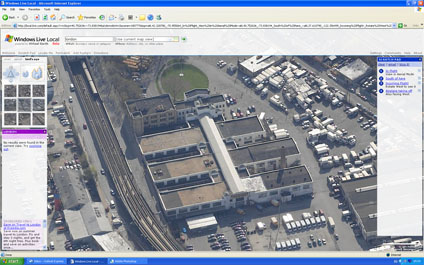
Microsoft’s Bing includes ‘Birds Eye’ images which provide various views around buildings. As such although it breaks all the ground rules of photogrammety by grabbing screen shots you can make a 3D model in Canoma:
The movie below details the basic output:
You could of course then port the model across to Google Earth in a slightly ironic way to create models for the 3D warehouse..
Eleven years on and their is still no software to match Canoma’s ease of use for 3D modelling, not even the beloved SketchUp – we miss it and if you can get hold of a copy on ebay we encourage you to. The output is not going to live up to the latest technology but for a few hours its worth going back to 1999 and realising just how good it was.
For more info take a look at Canoma.com – just try not to get upset at the details of Canoma 2.0 which was about to be released before the buyout to Adobe and they simply failed to do anything with it.