
Tagging technology – is the future bright?

By qrcodes, rfid, talesofthings
Tagging technology – is the future bright?
An invitation to think about where this technology might go and about its implications

Public Workshop 10 May 2010, 1-5 pm at ‘Inspace’ on Crichton Street, Edinburgh

More and more technologies are being developed to be ‘tagged’ to a person or object so that information about them can be recorded on a remote data base and read by third parties. This technology has the potential to influence all of our lives. Some applications appear harmless enough – such as the bar codes on products in shops – but others are raising concerns about privacy and surveillance. How do you feel about councils tagging wheelie bins in order to monitor what people are throwing out, for example? Or about the planned national identity cards? Yet other potential uses of tagging technology seem exciting. What if you could tag every object in your house so that you would never lose something ever again? Or if you could attach a memory to objects so that their stories are passed down through family generations? Maybe such developments could provide much needed help to people suffering from memory loss, increase our awareness of our own history or enhance our experiences of museums and galleries.

What’s in it for you?
Are you worried about tagging technologies or excited about future possible applications? Or do you simply want to find out more about the technology and/or possible implications? Whether you are someone who might benefit from tagging technology or want to find effective ways to protect privacy with the technology or are involved in developing new applications or just plain interested – we invite you to participate in a public event on the subject on Monday 10 May in Edinburgh.

The event will take the form of an interactive workshop, and include a technical demonstration of one type of tagging technology, called RFID, plus a film about possible dangers associated with it. This is an opportunity not only to find out more about the technology and consider what wider implications there may be; it is also a rare opportunity to shape the technology in some modest way – by contributing to the debate about possible problems and to opening up ideas about possible future developments.

Who is organising the event?
The event has been organised by TOTeM – the people behind the site http://www.talesofthings.com which you may of noticed mentioned here on digital urban recently. Through this event we want to better understand how diverse groups view technologies like RFID, and to encourage constructive criticism and ideas for future developments. This will help inform our research, and form the basis of a publication on public perceptions of new tagging technology.

We would also like to thank John Welford from NO2ID Edinburgh for his guidance on privacy and surveillance issues. NO2ID Edinburgh is one of many local groups across the UK campaigning against the introduction of compulsory ID cards and a National Identity Register.

Places are free but limited so if you would like to come please contact Jane Macdonald: Tel: 0131 221 6187 or email jane.macdonald@eca.ac.uk

We would love to get conversations going in the lead up to the event and after so if you have any initial feedback on the topic or indeed on the event itself then please do visit our blog http://rfidevent.wordpress.com/
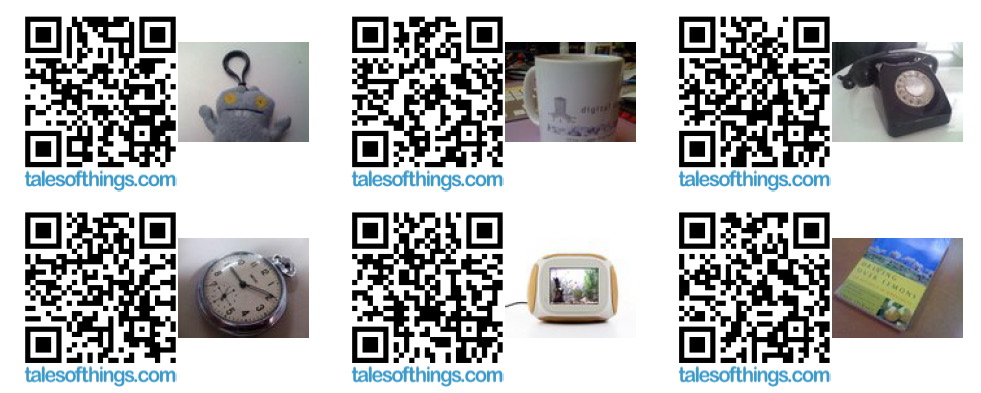
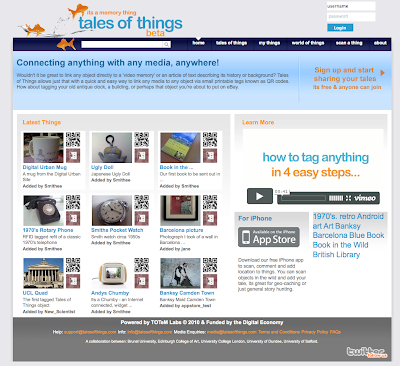
Tales of Things Goes Live – Its a Memory Thing

By internet of things, splimes, talesofthings

April 16th, 11.42 am and the research project born 18 months ago ‘Tales of Things‘ goes live, documented as the site is all about memories and attaching media to objects via qrcodes and rfid:

Tales of Things is part of a research project called TOTeM that will explore social memory in the emerging culture of the Internet of Things. Researchers from across the UK have provided this site as a platform for users to add stories to their own treasured objects and to connect to other people who share similar experiences. This will enable future generations to have a greater understanding of the object’s past and offers a new way of preserving social history.

Content will depend on real people’s stories which can be geo-located through an on-line map of the world where participants can track their object even if they have passed it on. The object will also be able to update previous owners on its progress through a live Twitter feed which will be unique to each object entered into the system.

The project will offer a new way for people to place more value on their own objects in an increasingly disposable economy. As more importance is placed on the objects that are already parts of people’s lives it is hoped that family or friends may find new uses for old objects and encourage people to think twice before throwing something away.

The Tales of Things site is located within the emerging technical and cultural phenomenon known as ‘The Internet of Things’. The term is attributed to the Auto-ID research group at MIT in 1999, and was explored in depth by the International Telecommunication Union who published a report bearing the same name at the United Nations net summit in 2005. The term, ‘Internet of things’, refers to the technical and cultural shift that is anticipated as society moves towards a ubiquitous form of computing in which every device is ‘on’, and every device is connected in some way to the Internet. The specific reference to ‘things’ refers to the concept that every new object manufactured will also be able to part of this extended Internet, because they will have been tagged and indexed by the manufacturer during production. It is also envisaged that consumers will have the ability to ‘read’ the tags through the use of mobile ‘readers’ and use the information connected to the object, to inform their purchase, use and disposal of an object.
 

The implications for the Internet of Things upon production and consumption are tremendous, and will transform the way in which people shop, store and share products. The analogue bar code that has for so long been a dumb encrypted reference to a shop’s inventory system, will be superseded by an open platform in which every object manufactured will be able to be tracked from cradle to grave, through manufacturer to distributor, to potentially every single person who comes into contact with it following its purchase. Further still, every object that comes close to another object, and is within range of a reader, could also be logged on a database and used to find correlations between owners and applications. In a world that has relied upon a linear chain of supply and demand between manufacturer and consumer via high street shop, the Internet of Things has the potential to transform how we will treat objects, care about their origin and use them to find other objects.

If every new object is within reach of a reader, everything is searchable and findable, subsequently the shopping experience may never be the same, and the concept of throwing away objects may become a thing of the past as other people find new uses for old things.

TOTeM is funded through a £1.39 million research grant from the Digital Economy Research Councils UK. The project is a collaboration between Brunel University, Edinburgh College of Art, University College London, University of Dundee and the University of Salford.


You can download the press release from here

Tales of Things Goes Live – Its a Memory Thing

By internet of things, splimes, talesofthings

April 16th, 11.42 am and the research project born 18 months ago ‘Tales of Things‘ goes live, documented as the site is all about memories and attaching media to objects via qrcodes and rfid:

Tales of Things is part of a research project called TOTeM that will explore social memory in the emerging culture of the Internet of Things. Researchers from across the UK have provided this site as a platform for users to add stories to their own treasured objects and to connect to other people who share similar experiences. This will enable future generations to have a greater understanding of the object’s past and offers a new way of preserving social history.

Content will depend on real people’s stories which can be geo-located through an on-line map of the world where participants can track their object even if they have passed it on. The object will also be able to update previous owners on its progress through a live Twitter feed which will be unique to each object entered into the system.

The project will offer a new way for people to place more value on their own objects in an increasingly disposable economy. As more importance is placed on the objects that are already parts of people’s lives it is hoped that family or friends may find new uses for old objects and encourage people to think twice before throwing something away.

The Tales of Things site is located within the emerging technical and cultural phenomenon known as ‘The Internet of Things’. The term is attributed to the Auto-ID research group at MIT in 1999, and was explored in depth by the International Telecommunication Union who published a report bearing the same name at the United Nations net summit in 2005. The term, ‘Internet of things’, refers to the technical and cultural shift that is anticipated as society moves towards a ubiquitous form of computing in which every device is ‘on’, and every device is connected in some way to the Internet. The specific reference to ‘things’ refers to the concept that every new object manufactured will also be able to part of this extended Internet, because they will have been tagged and indexed by the manufacturer during production. It is also envisaged that consumers will have the ability to ‘read’ the tags through the use of mobile ‘readers’ and use the information connected to the object, to inform their purchase, use and disposal of an object.
 

The implications for the Internet of Things upon production and consumption are tremendous, and will transform the way in which people shop, store and share products. The analogue bar code that has for so long been a dumb encrypted reference to a shop’s inventory system, will be superseded by an open platform in which every object manufactured will be able to be tracked from cradle to grave, through manufacturer to distributor, to potentially every single person who comes into contact with it following its purchase. Further still, every object that comes close to another object, and is within range of a reader, could also be logged on a database and used to find correlations between owners and applications. In a world that has relied upon a linear chain of supply and demand between manufacturer and consumer via high street shop, the Internet of Things has the potential to transform how we will treat objects, care about their origin and use them to find other objects.

If every new object is within reach of a reader, everything is searchable and findable, subsequently the shopping experience may never be the same, and the concept of throwing away objects may become a thing of the past as other people find new uses for old things.

TOTeM is funded through a £1.39 million research grant from the Digital Economy Research Councils UK. The project is a collaboration between Brunel University, Edinburgh College of Art, University College London, University of Dundee and the University of Salford.


You can download the press release from here

New Scientist and Beyond the Beyond – TalesofThings

By Media Coverage, talesofthings

New Scientist have a good write up this week on our new project – TalesofThings its also been picked up by Bruce Stirling over at Beyond Beyond on Wired and to be honest we are blown away.

News in, the iPhone app has been accepted so with a few more tweaks and plugging in of wires we will be ready to go beta end of the week.

We also have some neat gadget hacks including an iPhone/Android RFID reader on the cards which we plan to put onto MAKE or such like so you can build your own kit.

News as ever will be here on digital urban and via the TalesofThings Twitter Feed.

We will get back to the more general posts btw, soon as we get chance, and news on that MRes in Advanced Spatial Analysis and Visualisation which we direct, next week.

Update – the MRes details are now online along with application and entry.

Close Menu

About Salient

The Castle
Unit 345
2500 Castle Dr
Manhattan, NY

T: +216 (0)40 3629 4753
E: hello@themenectar.com

Archives