Stop motion timelapse can be a very powerful way to communicate a city, director Davie Lee of davidleedop.com has used the technique to capture his return trip to Japan.
It is interesting how evocative of place a 41 second clip can be…
Panoramic and spherical-view cameras today are by and large one of three types:
1. A single camera with wide-angle optics, such as a fisheye lens or curved mirror; 2. Multiple cameras looking out directly in different directions; or 3. Multiple cameras looking out off flat mirrors, which is FullViews patented approach.
Whereas multiple cameras offer much higher resolution than any single camera, multiple cameras looking out directly are in general incapable of producing seamless, artifact-free and blur-free composite images no matter what, because of parallax. FullView evades parallax through its patented approach in which multiple cameras look out off flat mirrors such that all the cameras are effectively looking out in different directions but from the same single viewpoint. As a result, FullViews composite images, whether a video or still view panorama, and irrespective of their resolution, are always seamless, artifact-free and blur-free, and they provide much higher resolution than outwardly pointing cameras.
The Google Tech talk below by Vic Nalwa, President of FullView, is a must see for anyone interested in panoramic imagery:
Panoramic and spherical-view cameras today are by and large one of three types:
1. A single camera with wide-angle optics, such as a fisheye lens or curved mirror; 2. Multiple cameras looking out directly in different directions; or 3. Multiple cameras looking out off flat mirrors, which is FullViews patented approach.
Whereas multiple cameras offer much higher resolution than any single camera, multiple cameras looking out directly are in general incapable of producing seamless, artifact-free and blur-free composite images no matter what, because of parallax. FullView evades parallax through its patented approach in which multiple cameras look out off flat mirrors such that all the cameras are effectively looking out in different directions but from the same single viewpoint. As a result, FullViews composite images, whether a video or still view panorama, and irrespective of their resolution, are always seamless, artifact-free and blur-free, and they provide much higher resolution than outwardly pointing cameras.
The Google Tech talk below by Vic Nalwa, President of FullView, is a must see for anyone interested in panoramic imagery:
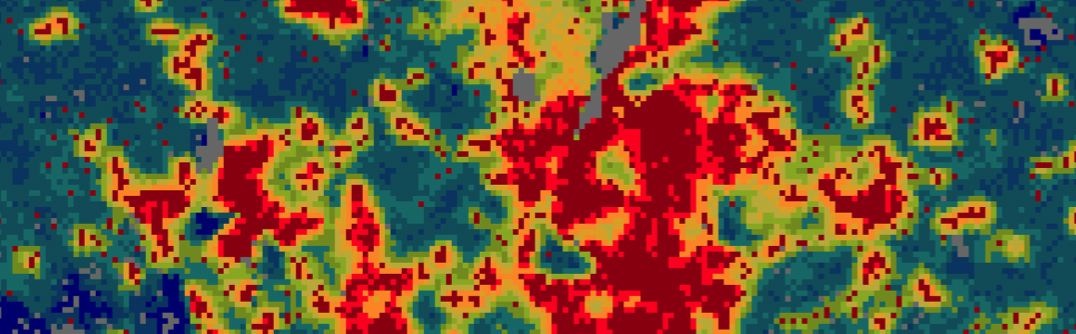
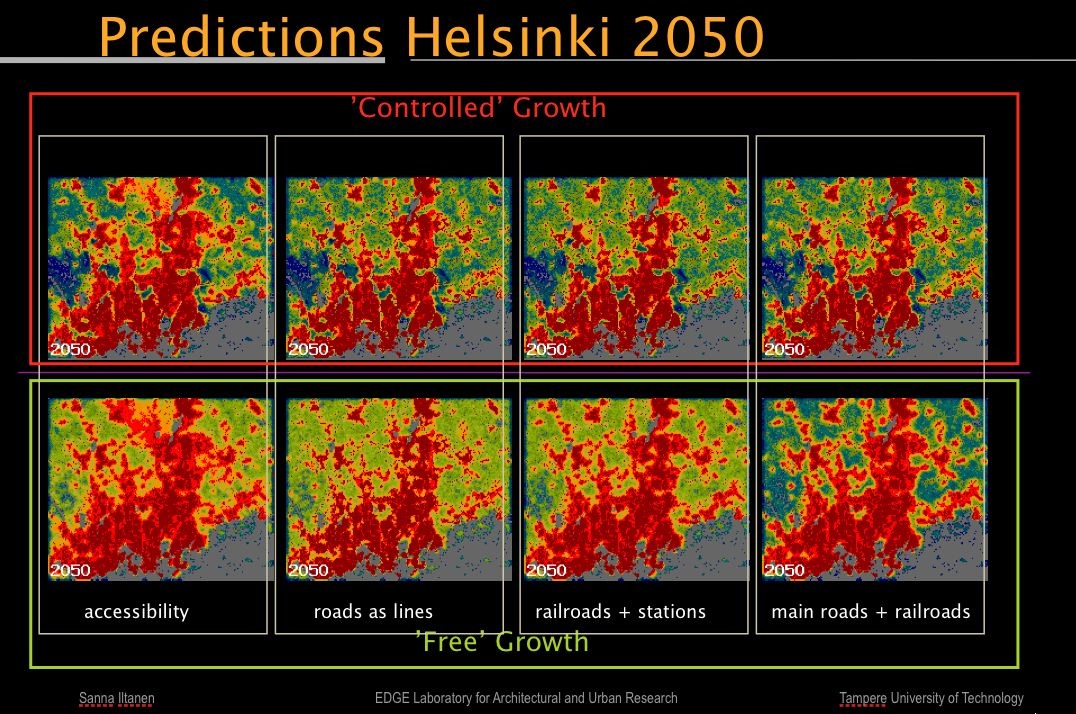
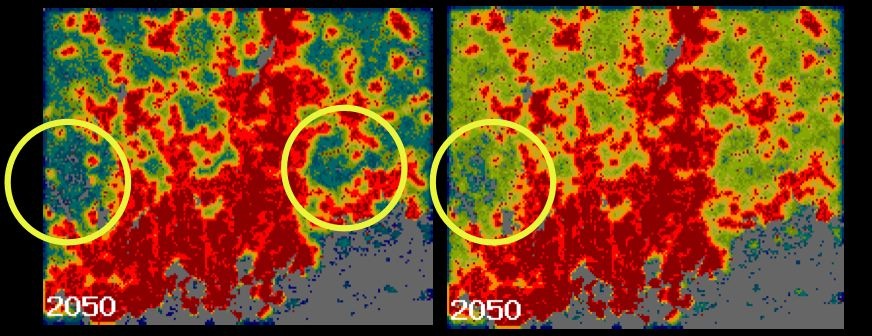
Sanna Iltanen from the EDGE Laboratory for Architecture and Urban Research (Tampere University of Technology) who is currently a visitor at our lab gave a talk the other day entitled “Experiments with SLEUTH-model”. She discussed the SLEUTH model, the input data needed to initialize the model, its calibration and explored some simulation results from different land-use policies in the Helsinki and Turku city regions of Finland.
The SLEUTH model is a tightly coupled, modified cellular automaton model of urban growth (and other land class change) which has been applied to over 100 cities and regions over the last decade (click here to see some of them). For example, it has been used to explore future land use patterns under different policy scenarios in the Washington-Baltimore metropolitan area.
The name SLEUTH was derived from the simple image input requirements of the models: Slope, Land cover, Exclusion, Urbanization, Transportation, and Hillshade.NASA have also used the model to look at the growth of Washington. The model was applied to 23,700 square kilometers (9151 sq. miles) of the Washington-Baltimore metropolitan area. The initial aim was to simulate the impact of future policy scenarios on the area and Chesapeake Bay watershed.