
Locally Adapted Projections to Reduce Panorama Distortions

By Panoramas, panoramic imagery


The movie below is supplementary to a paper entitled Locally Adapted Projections to Reduce Panorama Distortions presented at the Eurographics Symposium on Rendering 2009.

The paper introduces locally-adapted projections for panoramic images. Defined as a continuous projection surface consisting of both near-planar and curved parts the simple and intuitive user interface allows the specification of regions of interest to be mapped to the near-planar parts, thereby reducing bending artifacts. The authors demonstrate the effectiveness of their approach on a variety of panoramic and wide angle images, including both indoor and outdoor scenes. It should however be noted that the ideas behind the paper are subject to dispute with the idea and proof of concept linked to the work of Helmut Dersch. Helmut is a well known innovator in the field and as he states omitting acknowledgments and references in high-level academic papers for sourced data, experiments or techniques is not acceptable. We concur completely with this view having seen various of our own labs work plagiarised over the years and action taken.

The link to the full paper has been removed in light of the update to the post.
Locally Adapted Projections to Reduce Panorama Distortions

By Panoramas, panoramic imagery


The movie below is supplementary to a paper entitled Locally Adapted Projections to Reduce Panorama Distortions presented at the Eurographics Symposium on Rendering 2009.

The paper introduces locally-adapted projections for panoramic images. Defined as a continuous projection surface consisting of both near-planar and curved parts the simple and intuitive user interface allows the specification of regions of interest to be mapped to the near-planar parts, thereby reducing bending artifacts. The authors demonstrate the effectiveness of their approach on a variety of panoramic and wide angle images, including both indoor and outdoor scenes. It should however be noted that the ideas behind the paper are subject to dispute with the idea and proof of concept linked to the work of Helmut Dersch. Helmut is a well known innovator in the field and as he states omitting acknowledgments and references in high-level academic papers for sourced data, experiments or techniques is not acceptable. We concur completely with this view having seen various of our own labs work plagiarised over the years and action taken.

The link to the full paper has been removed in light of the update to the post.

Mirrors Edge: A Change of Pace in Architectural Visualisation

By Architectural Visualisation, Game Engines


Suddenly all the architectural animations we have featured here on digital urban seem rather dull. The movie below is a remix Mirror’s Edge Music Video 2 by Enhaton, music Madonna – Jump Remix with Mirror’s Edge running on a PC and additional remixing using Adobe Premiere CS4 :


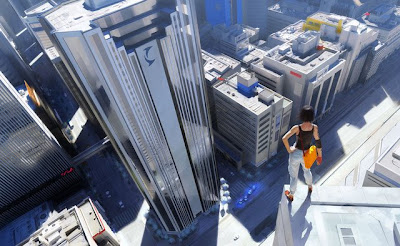
Mirror’s Edge is a first person adventure game currently under development by DICE, available on Xbox 360, PS3 and PC its shows innovative use of the cityscape:


The story is based around a city…

where information is heavily monitored, agile couriers called Runners transport sensitive data away from prying eyes. In this seemingly Utopian paradise, a crime has been committed and now you are being hunted. You are a Runner called Faith – and this innovative first-person action-adventure is your story.

The PC version is moddable which opens up quite a few opportunities for how we explore architecture and the cityscape in general, yet another example of the power of game engines for urban visualisation.

Mirrors Edge: A Change of Pace in Architectural Visualisation

By Architectural Visualisation, Game Engines


Suddenly all the architectural animations we have featured here on digital urban seem rather dull. The movie below is a remix Mirror’s Edge Music Video 2 by Enhaton, music Madonna – Jump Remix with Mirror’s Edge running on a PC and additional remixing using Adobe Premiere CS4 :


Mirror’s Edge is a first person adventure game currently under development by DICE, available on Xbox 360, PS3 and PC its shows innovative use of the cityscape:


The story is based around a city…

where information is heavily monitored, agile couriers called Runners transport sensitive data away from prying eyes. In this seemingly Utopian paradise, a crime has been committed and now you are being hunted. You are a Runner called Faith – and this innovative first-person action-adventure is your story.

The PC version is moddable which opens up quite a few opportunities for how we explore architecture and the cityscape in general, yet another example of the power of game engines for urban visualisation.

Close Menu

About Salient

The Castle
Unit 345
2500 Castle Dr
Manhattan, NY

T: +216 (0)40 3629 4753
E: hello@themenectar.com

Archives