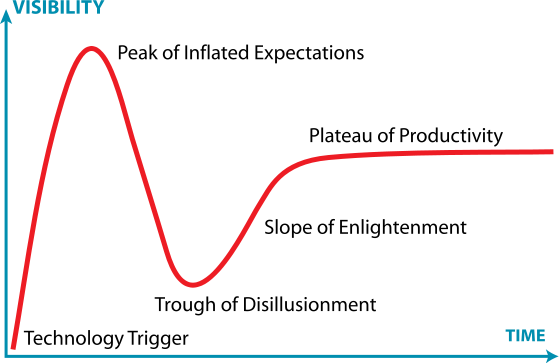
Wolfgang Gentzsch, adjunct professor of computer science at Duke University in Durham, and visiting scientist at RENCI Renaissance Computing Institute at UNC Chapel Hill, is currently presenting a key note at the 4th International Conference on e-Social Science. Focusing on Grid Computing of note is his view that the Grid is currently in the ‘trough of disillusionment’ in terms of the Gartner’s Hype Cycle.
A hype cycle in Gartner’s interpretation comprises 5 steps:
- “Technology Trigger” — The first phase of a hype cycle is the “technology trigger” or breakthrough, product launch or other event that generates significant press and interest.
- “Peak of Inflated Expectations” — In the next phase, a frenzy of publicity typically generates over-enthusiasm and unrealistic expectations. There may be some successful applications of a technology, but there are typically more failures.
- “Trough of Disillusionment” — Technologies enter the “trough of disillusionment” because they fail to meet expectations and quickly become unfashionable. Consequently, the press usually abandons the topic and the technology.
- “Slope of Enlightenment” — Although the press may have stopped covering the technology, some businesses continue through the “slope of enlightenment” and experiment to understand the benefits and practical application of the technology.
- “Plateau of Productivity” — A technology reaches the “plateau of productivity” as the benefits of it become widely demonstrated and accepted. The technology becomes increasingly stable and evolves in second and third generations. The final height of the plateau varies according to whether the technology is broadly applicable or benefits only a niche market. (see Wikipedia for more info)
In terms of e-Social Science the Grid is yet to deliver compared to the hype, personally at CASA we have moved away from Grid based services, time will tell if the Grid can reach a Plateau of Productivity?
Perhaps the key to the Grids move down the cycle is its complexity for the end user, especially compared to Cloud Computing. The consumer wave is heading towards the Cloud as it is service based, Grid Computing is still over complex and perhaps it has lost the perspective of the end user…
 Feel free to get in touch with us either with questions on a blog post, news items, hints and tips, requests for talks or enquiries regarding our consultancy services.