Become an Author: Digital Urban’s Worlds Worst Urban Places and Spaces Book

By Book

We are looking for authors to contribute to a new book on the Worlds Worst Urban Places and Spaces. The book embraces the concept of Web 2.0 by being based around Flickr and self publishing, in essence it is a nod to the changing world of publishing, you the readers and the ability to print on demand.

Whats it About?

The book is aimed to be a tour around the worlds worst examples of architecture, urban design and urban space as photographed by the readers of this blog. Using photographs and short pieces of text uploaded via Flickr we are proposing 100 + pages with a foreword by ourselves at Digital Urban.

How Can i Take Part?

Simply go out into your local urban environment and photograph anything that you think is an example of poor architecture, urban design or use of space. It could be a photograph of a run down phonebox or a disused building, perhaps a concrete monstrosity from the 1970’s or anything that you think fits.

Once you have your photograph you can simply upload it to our newly created group on Flickr, Worlds Worst Urban Spaces and Place including a description of between 100 and 250 words. Its as simple as that.

Can i Vew Progress?

We have created a new blog page ‘Worlds Worst Urban Places and Spaces‘ where each new submission will be posted, we will put in some light editing before posting so don’t worry about your writing skills per se. This will also allow you to see what text will be included in the book.

When will the Book be Published?

The book will be published when we have enough content so that is down to you, it could be out next week, next month or in the next year. The beauty about Web 2.0 and self publishing is that we can send it to print as soon as the content is there and update it on a regular basis.

How Much Will it Cost?

For a book of 100 pages we are looking at approximately $25 although final details are subject to change, we will probably be using Blurb as our publisher due to their reputation for high quality colour reproduction.

Will you make a Profit From the Book?

The book will be sold at cost and is a collective community effort in the spirit of web 2.0 and the blog in general, as such it will be non-profit.

So welcome to the start of a book completely based on the readers of this blog, we hope it takes off and a book is out of the door in the next few months, a collective book where you are the author.

See the Worlds Worst Urban Spaces and Places blog page for the latest posts (note this will take shape over the coming weeks as content is sent in via Flickr)

3D Collaborative Geographic Information Systems – Virtual London in Second Life

By GIS, Google Earth, Importing into Second Life, TDC GIS, Virtual London

Three Dimensional Collaborative Geographic Information Systems (3DC/GIS) are in their infancy, Google Earth opened up the concept of three dimensions to the mainstream but issues with data copyright, the inability to effectively tag data to buildings and the asynchronous nature of the platform have limited developments.

Second Life however provides a synchronous platform with the ability to tie information, actions and rules to objects opening the possibility of a true multi-user geographical information system. It has been notoriously difficult to import 3D data into the Second Life but at CASA we have managed to import our Virtual London model of 3 million plus buildings into a scrolling map. The map is built from prims that ‘res’ our of a central point to build accurate models based on Ordnance Survey MasterMap with height data supplied by InfoTerra.

The movie embedded below illustrates a section of Canary Wharf, London building in real-time, note the movie represents work in progress:

Music by The Tartan Rascals

Each object can be tagged with data, coloured or replaced at will within the collaborative environment that is Second Life. In additional to this rule sets can be assigned to sub-objects allowing agent based models to be integrated into the system.

Our next step is to import a live GPS feed of a tagged member of CASA onto a scaled avatar on the map, the 3D buildings will in theory scroll and build as the person walks around London in real life.

We are also working on tagging information and textures to the facades, allowing perhaps for the first time a public 3DC/GIS to be feasible.

If you have Second Life installed you can visit us by clicking here – you will get a red arrow pointing skywards, simply fly up to our section of Second Nature island in association with the Nature Network.

You can download Second Life from here.

Thanks go to Joel at CASA for writing the code.

3D Printing at Home: Fab@Home

By 3D Printing

In our previous article on 3D Architectural Printing we looked at the use of commercial 3D printing for the creation of physical city models thanks to those nice people at Sweet Onions Creations. We would argue that we are at the start of a revolution in home based manufacture using these machines, within the next 10 years design files will be shared as much as music files are today to print out new objects in the home.

Central to this is the Fab@Home project, 3D Printers or Fabbers as they are known are a relatively new form of manufacturing that builds 3D objects by carefully depositing materials drop by drop, layer by layer.

Slowly but surely, with the right set of materials and a geometric blueprint, you can fabricate complex objects that would normally take special resources, tools and skills if produced using conventional manufacturing techniques.

A fabber can allow you to explore new designs, email physical objects to other fabber owners, and most importantly – set your ideas free. Just as MP3s, iPods and the Internet have freed musical talent, we hope that blueprints and fabbers will democratize innovation.

While several commercial systems are available, their price range – tens of thousands, to hundreds of thousands of dollars – is typically well beyond what an average home user can afford. Furthermore, commercial systems do not usually allow or encourage experimentation with new materials and processes. But more importantly, most – if not all – commercial system are geared towards making passive parts out of a single material.

The goal of the Fab@Home project is to explore the potential of universal fabrication: Machines that can use multiple materials to fabricate complete, active systems.

New Scientist have uploaded onto YouTube a 5 minute long interview with Evan Malone a co-founder of the Fab@Home project. The clip is well worth a look at it provides examples of the home based 3D printer to date as well as an insight into the future when these become part of everyday life:

The AT&T Tech channel also have a short film on the Fabber.

The system is starting to get into the hands of other research labs and individuals, a Google MyMaps project has been set up to map the spread of the Fabber with the locations so far embedded below:


View Larger Map

If you want to make your own, costs are currently coming in at $2300 with full details and parts via the Fab@Home website.

Finally, keep an eye on the Fab@School Blog as they have just received parts and will be blogging their progress with the machine.

Vectorising Banksy – Camden Town

By Banksy, Vector Magic

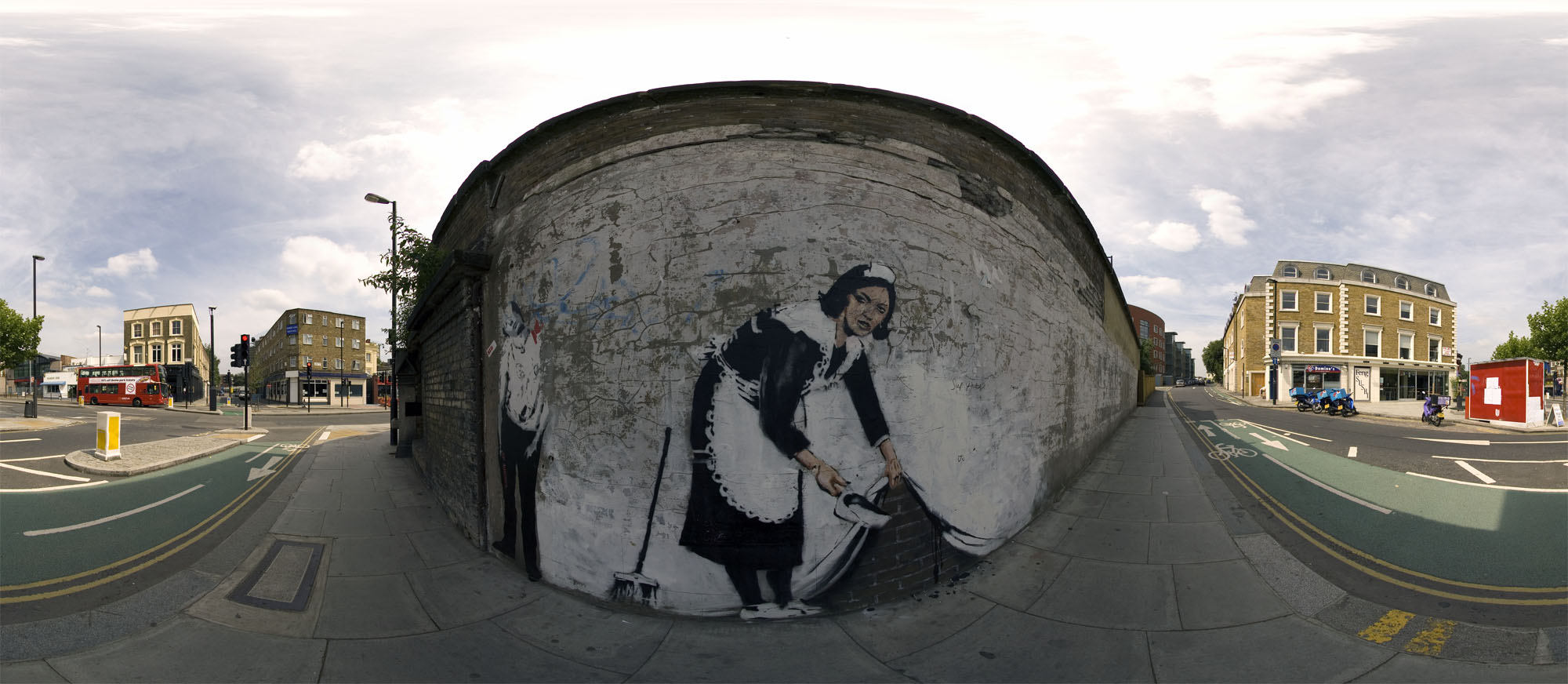
The panorama was captured in front of the Chambermaid stencil by the artist Banksy, in May 2006 on the wall of the Roundhouse in Camden. According to the Camden New Journal Article the maid is a portrait of Leita who worked in a Hotel in Los Angeles.

Using the online tool Vector Magic – see our earlier post – it is possible to quickly and easily create high quality vector output from images and Banksy’s Chambermaid is a case in point.

You can compare the photograph and the vectorised version side by side from here.

View the Quicktime panorama of Banksy’s Stencil at the Roundhouse, Camden, London (2.9Mb).

You can also simply view a larger version of the original image (290K).

Close Menu

About Salient

The Castle
Unit 345
2500 Castle Dr
Manhattan, NY

T: +216 (0)40 3629 4753
E: hello@themenectar.com

Archives