
Second Life/Web 2.0? Virtual Worlds in 1998 is Where It Was At…

By Posts

Second Life, collaborative working, voice chat is so of the moment but it was also all the rage in 1998. This post takes a look back to the day when if we had money we would invested in virtual worlds. Hindsight is however a good thing as most of the worlds that showed potential in 1998 were lost when the web bubble burst, but if you think Web 2.0 is new we think its just picking up the ideas from a decade ago:

Second Life has just enabled voice chat within its virtual world browser, a system called Onlive which intergrated real-time voice-based vommunication in VRML (Virtual Reality Modelling Langauge) envionments. A screenshot of use using Onlive is picutred below, note the Netscape icon in the toolbar to age the image:

Virtual Worlds Circa 1998: How Much Has Changed?

By Best Of, Second Life, virtual worlds


Second Life, collaborative working, voice chat and others of the Web 2.0 world are so of the moment but the concepts were also all the rage in 1998. This post takes a look back to the day when if we had money we would have invested in virtual worlds – the next big thing.

Hindsight is however a good thing as most of the worlds that showed potential in 1998 were lost when the web bubble burst, but if you think Second Life is new we think its just picking up the ideas from a decade ago.

Voice Chat

Second Life has just enabled voice chat within its virtual world browser, a system called Onlive integrated real-time voice-based communication in VRML (Virtual Reality Modelling Language) environments. A screenshot of our use of Onlive is pictured below, note the Netscape icon in the toolbar to date the image:
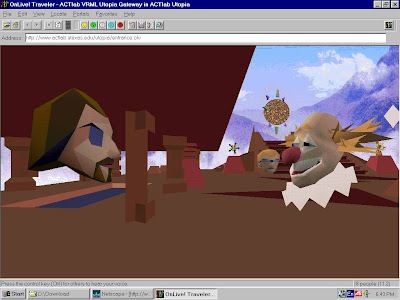
To communicate the user was required to press the ctrl key on the keyboard and talk into a connected microphone. The user’s voice was then encoded and transmitted into the virtual environment using automatic voice synthesis and three-dimensional audio. The result was real-time conversation with lip synchronised avatars.

With the emphasis on lip synchronisation the avatars were represented as single floating heads which limited to some extent the level of perceived interaction with the environment. To be honest the three dimensional scenes were merely backdrops and the quality of the audio was often poor resulting in dropouts and confused conversations. Indeed, the most widely used phrase in Online was ‘pardon’, although at least in was in three-dimensional audio.

White Boards and Integrated Powerpoint

Integrating whiteboards and powerpoint presentations is a central part of Second Life, especially for its use by business and academic communities. Setting up a powerpoint presentation takes time and requires scripting, Holodesk however had it built in.

Holodesk was a VRML 2.0 based shared virtual environment from a Pittsburgh-based company called Telepresence. Voice chat was also built into the system but limited to two users at any one time compared to the multiple voice communication of Onlive. Notable additional features were the ability to communicate via shared whiteboards and views prepared graphic slide-based presentations within the virtual environment.

Pictured below is a section of our London work in Holodesk (we were experimenting with scale):
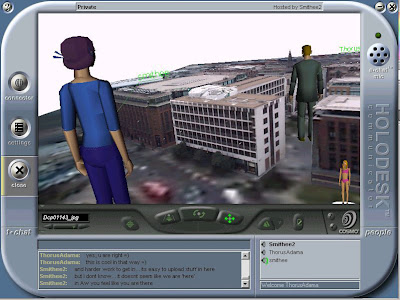
A key limitation of using VRML for multi-user worlds was the inability for any changes to the world to be saved. In essence a VRML world was a scene which although offering some level of interaction did not involve any level of collaboration.

Collaboration and Tool Box Building

If we had bet on any technology system becoming main stream it was the ActiveWorld’s browser, back in 1998 it did most of the things now possible in Second Life.
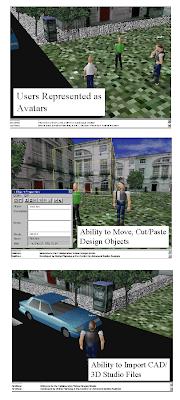
ActiveWorld’s was not by any means the first Virtual Worlds system but it, in our view, stands the test of time as one of the best. One needs to bare in mind that back in 1998 Internet technology was still developing and the ability to collaboratively build and share data in a three dimensional world where one is represented as an avatar was like viewing the future.

In addition to being able to build from a large subset of objects the ActiveWorlds server could import objects in .rwx or Renderware format. This opened up the world of architecture with a direct input path from AutoCad and 3DStudio Max.

If you take a look at The ARCH of note is the fact that one of the things architects and users in general are waiting for is the ability to import objects into Second Life from third party programs.

To discuss all things virtual the Avatars 98 Conference was held in ActiveWorlds, run by the Contact Consortium it provides a snapshot of the time:

We guess most of the users are now to be found somewhere in Second Life, of note though is how quick users can be to change to the next big system.

Internet hype arrives in waves of innovation, the current wave is Second Life, as for the next wave? Wasn’t there a rumour of a Google Virtual Environment last week?

To Teleport or Not to Teleport: Travelling in Virtual Worlds

By Second Life, virtual worlds

Methods of travel within virtual worlds differ according to distance and the rules imposed by the system. The most common method to move large distances is the teleport – allowing new locations to be reached according to a Cartesian co-ordinate system. Teleports are common place within environments such as Second Life and ActiveWorlds with teleportation achieved through either selecting a location on a map or clicking on an object which has been setup with a teleportation script.

As an example, in the panoramic sphere below the small red triangle is a teleport object taking the user back to the main section of our work on Second Nature Island within Second Life.

The same is true of ActiveWorlds with teleports being a key feature of the ability to jump between servers and chosen locations. However, the ability to teleport was not always part of the original ActiveWorlds systems which evolved through the influence of Neal Stephenson’s seminal science fiction novel Snow Crash.

In Snow Crash, the ability to teleport was blocked:

You can’t just materialise anywhere in the Metaverse… this would be confusing and irritating to the people around you. It would break the metaphor (Neal Stephenson, Snow Crash, 1996, page 42).

Pressure from users resulted in teleportation stations being introduced at select points around the central section of ActiveWorlds original environment known as AlphaWorld, but it caused concern amoung the developers. The New World Times, a virtual newspaper, reported in 1998 that ‘there is still some concern that teleportation will ruin the simulation of reality in AlphaWorld‘.

Teleportation was subsequently introduced throughout the ActiveWorlds system and it is now central to the majority of virtual environments. Indeed within Second Life teleportation is integral to moving around the world. Pictured below is a map of teleports in our own ActiveWorld circa 1999 (click for a larger version):

In 1998 the developers of ActiveWorlds were worried that teleporting would ruin the simulation, by 2007 the expanse of virtual environments has meant that teleportation is the only option.

In Second Life you can materialise anywhere in the Metaverse, it is not confusing or irritating to the people around you and indeed perhaps even enhances the metaphor…

To Teleport or Not to Teleport: Travelling in Virtual Worlds

By Second Life, virtual worlds

Methods of travel within virtual worlds differ according to distance and the rules imposed by the system. The most common method to move large distances is the teleport – allowing new locations to be reached according to a Cartesian co-ordinate system. Teleports are common place within environments such as Second Life and ActiveWorlds with teleportation achieved through either selecting a location on a map or clicking on an object which has been setup with a teleportation script.

As an example, in the panoramic sphere below the small red triangle is a teleport object taking the user back to the main section of our work on Second Nature Island within Second Life.

The same is true of ActiveWorlds with teleports being a key feature of the ability to jump between servers and chosen locations. However, the ability to teleport was not always part of the original ActiveWorlds systems which evolved through the influence of Neal Stephenson’s seminal science fiction novel Snow Crash.

In Snow Crash, the ability to teleport was blocked:

You can’t just materialise anywhere in the Metaverse… this would be confusing and irritating to the people around you. It would break the metaphor (Neal Stephenson, Snow Crash, 1996, page 42).

Pressure from users resulted in teleportation stations being introduced at select points around the central section of ActiveWorlds original environment known as AlphaWorld, but it caused concern amoung the developers. The New World Times, a virtual newspaper, reported in 1998 that ‘there is still some concern that teleportation will ruin the simulation of reality in AlphaWorld‘.

Teleportation was subsequently introduced throughout the ActiveWorlds system and it is now central to the majority of virtual environments. Indeed within Second Life teleportation is integral to moving around the world. Pictured below is a map of teleports in our own ActiveWorld circa 1999 (click for a larger version):

In 1998 the developers of ActiveWorlds were worried that teleporting would ruin the simulation, by 2007 the expanse of virtual environments has meant that teleportation is the only option.

In Second Life you can materialise anywhere in the Metaverse, it is not confusing or irritating to the people around you and indeed perhaps even enhances the metaphor…

Close Menu

About Salient

The Castle
Unit 345
2500 Castle Dr
Manhattan, NY

T: +216 (0)40 3629 4753
E: hello@themenectar.com

Archives