Bionatics announces LandSIM3D®, Landscape and Urban Simulation Software

By LandSIM 3D, Software Reviews

Bionatics, a developer of 3D plant, landscape modeling and simulation tools for the 3D industry, has just announced the upcoming release of its newest simulation software: LandSIM3D®.

LandSIM 3D – is by way of the press release – a new generation of simulation software developed for analysis, design, planning and presentation of landscape and urban projects. With Bionatics kind permission we have uploaded a sample movie of LandSIM as detailed below:

LandSIM3D will be revealed for the first time in the United Kingdom during two exclusive conferences scheduled in London, October 15th and Manchester, October 16th with prestigious guests such at Scott Wilson, The Ordnance Survey and the Forestry Commission of France invited to testimony about their experience with LandSIM3D:

“The upcoming release of LandSIM3D is a great opportunity for a large range of urban planners and landscape professionals since this new 3D tool will give them an ability to rapidly visualize large geographical or territorial information data that are often complex and difficult to understand in a simple and convenient way” explains Stephan GOURGOUT, Sales Director and co-founder of Bionatics. “LandSIM3D makes it possible to quickly correlate vectorial data coming from GIS and aerial photos to deliver a realistic and geo-referenced 3D model: an accurate base from which projects can then be inserted and studied with their alternatives and their environmental impacts”.

LandSIM3D is different from traditional 3D imagery solutions, normally reserved for computer graphics experts. It offers a whole gamut of features and services which are directed towards landscape and urban planning professionals and includes a simple interface which guides the operator with the new use of the 3D. LandSIM3D thus proposes to accompany the professionals in their everyday practice through the following key steps:

  • MODEL the existing landscape in 3D to better analyze and study it in a few hours only.
  • INSERT your architecture, infrastructure, urban or even new landscape project simply in this existing environment.
  • STUDY the possible alternatives of your project, its environmental impacts and its evolution in the future.
  • PRESENT your decisions and EXPLAIN your choices thanks to the interactive 3D visualization. A must have tool for your public meetings and presentations.

LandSIM3D is scheduled to be released in November 2007, in United Kingdom.

Registration for the LandSIM3D UK launch tour can be made online at www.landsim3d.com.

For more information about LandSIM3D, contact Bionatics +33 1 56 02 04 20 or by email: infolandsim3d@bionatics.com

We hope to be at the launch in London and will carry full review of the software as soon as we get hold of a trial version…

Find out more about LandSIM3D via the Bionatics product page.

Real Estate Goes Virtual

By Architectural Visualisation

With today’s toolset the ability to visualise, communicate and populate real estate is real, cheap and more importantly easy to do.

Indusgeeks have uploaded a movie to YouTube providing a walkthrough of the concept. They divide virtual real estate into 3 parts:

  1. Location – Visualisation via Google Earth
  2. Scrutiny – Examining the building in 3D Max
  3. Second Life – Exploring the building within the virtual environment

Movie embedded below:

The overview is especially useful if you are deciding what route to deliver to clients in terms if interactivity and visualising the design. Central to the process is 3D Studio Max and at CASA we are working on an exporter as we speak so you don’t have to rebuild in Second Life.

See indusgeeks.com for more info.

The Model City – Working Paper Series 113

By Publications, Working Papers

Professor Michael Batty at our lab is one of the leading lights in city based modelling, in his latest working paper he defines how the term ‘model’ is now central to our thinking about how we understand and design cities.

In the paper:

We suggest a variety of ways in which we use ‘models’, linking these ideas to Abercrombie’s exposition of Town and Country Planning which represented the state of the art fifty years ago.

Here we focus on using models as physical representations of the city, tracing the development of symbolic models where the focus is on simulating how function generates form, to iconic models where the focus is on representing the geometry of form in both two and three dimensions.

Our quest is to show how digital representation enables us to merge and manipulate form into function and vice versa, linking traditional architectural representation to patterns of land use and movement. Mathematics holds the key to simulation of many kinds and computers now enable us to move effortlessly from the material world of atoms to the ethereal world of bits and back.

These new tools also provide us with powerful ways of showing how the real is able to morph into the ideal and vice versa. We argue that this digital world which parallels the material, now gives us unprecedented power to understand and explore cities in ways that Abercrombie could only speculate upon, and we conclude by anticipating how we might respond to the new challenges posed by unlimited access to these virtual worlds.

The paper is well worth a download (2.3Mb, PDF) and covers a lot of the work and topics featured in the blog.

We will have a new Working Paper, entitled The Visual City available for download shortly.

Top 5 Urban Gadgets and Software

By Gadgets, N95, Power Monkey, Top 5 Gadgets and Software

This blog is all about capturing the urban realm via low end digital means. As such over the years we have relied on various gadgets, software and pieces of kit which make the job easier.

In our view the 5 essential items for capturing and visualising the urban environment are:

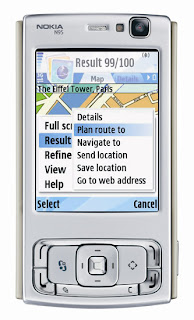
Number 1: Nokia N95

Despite a few issues with battery life the integrated GPS, 5 mega pixel camera and ability to upload geo-tagged images directly to services such as Flickr make the Nokia N95 an all round essential tool.

The camera’s quality to high enough for photomodelling in SketchUp and the addition of the admittedly slow to get a fix GPS is adequate for geo-locating. Stick it to a kite and you have instant aerial photography, or rotate around a single spot for a high resolution panorama (see our tutorial).

All in all the N95 does it all although in rapidly moving times the interface is slightly clunky and it could well be soon knocked off the list with up and coming models.

Number 2: Google EarthGoogle Maps

To have essentially free software in at number 2 is quite an achievement. Google Earth and Google Maps have changed the way in which we share and communicate geographic information, the ability to tag data, upload images and import 3D models in the case of Google Earth into a common environment on a global scale is amazingly something we now almost take for granted.

The simple fact is that if you want to share geographic information at this time and point it has to be in Google Earth or Google Maps – see our Working Paper for tools and methods to import and visualise data.

Number 3: The Nodal Ninja

The Nodal Ninja is perhaps slightly unknown outside of the panoramic photography industry but it is an essential item. Priced at $229 the Nodal Ninja is one of the cheapest yet most versatile camera mounts.

The important point with capturing either Giga Pixel images or panoramic 360×180 scenes is to ensure that the camera rotates around a single nodal point. The Nodal Ninja works with the majority of cameras, allowing you to switch between high resolution images for professional capture or a light weight point and shoot camera for off the cuff shots.

Central to its position at number 3 is its light weight, we have used a number of panoramic heads in our time and carrying them around town is often hard work. With the Nodel Ninja it is easy to transport and as such should be part of the regular kit when capturing any urban images.

Number 4: The Power Monkey Explorer

The Power Monkey is a portable power charger than can extend your Nokia N95’s life by up to 4 times. Portable and light weight the main unit can be charged up either via the supplied Solar Slave or via a USB cable if you don’t have access to a mains outlet.

Supplied with a number of sockets to fit and power gadgets from digital cameras to Ipods and phones it finally means that you wont be out and about only to find you have run out of power.

We will have a full review of the Power Monkey Explorer in the next few days…

Number 5: Google SketchUp

Google products feature three times in this simple top 5 list, Google have changed the way in which we work and in a 3D concept Google SketchUp is a leader in its field. Again available free of charge unless you require higher end import and export options SketchUp is one of the most enjoyable pieces of software to use. The ability to simply load in your images and trace over them to create photorealistic models is something that used to be limited to high end photogrammetric software.

We know that there are users our there that view SketchUp as a tool for the masses and frown upon its simple tool set and interface. Yet this is what its all about, mass participation in modeling and geographic information using simple to use yet powerful toolsets.

In essence this is the start of a longer list of recommend hardware and software of note is our lack of mention of ESRI, 3D Max, Laser Scanners or other high end software/hardware.

The market is changing and with it both the software and levels of hardware required, to be continued..

Close Menu

About Salient

The Castle
Unit 345
2500 Castle Dr
Manhattan, NY

T: +216 (0)40 3629 4753
E: hello@themenectar.com

Archives