
Low-Cost Mapping and Publishing Methods for Landscape Architectural Analysis and Design in Slum-Upgrading Projects

By Posts

Future Internet carries on the theme of web based mapping with its latest publication by Paar, P.; Rekittke, J. Low-Cost Mapping and Publishing Methods for Landscape Architectural Analysis and Design in Slum-Upgrading Projects . Future Internet 2011, 3, 228-247.
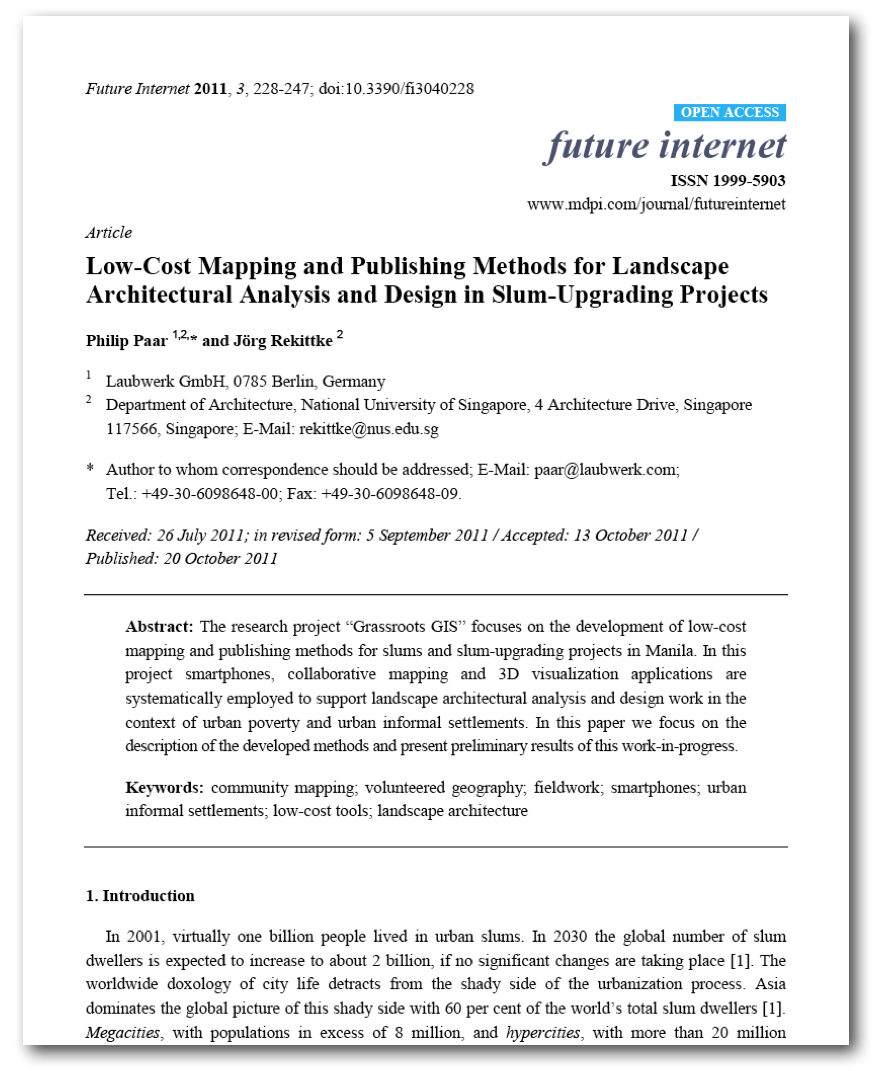
The research project “Grassroots GIS” focuses on the development of low-cost mapping and publishing methods for slums and slum-upgrading projects in Manila. In this project smartphones, collaborative mapping and 3D visualization applications are systematically employed to support landscape architectural analysis and design work in the context of urban poverty and urban informal settlements. In this paper we focus on the description of the developed methods and present preliminary results of this work-in-progress.

The paper is part of a special issue edited by Dr. Christopher Pettit Principal Research Scientist and Research Manager, Spatial Information Sciences, Department of Primary Industries Victoria, Australia and Dr. Arzu Coltekin,Department of Geography, University of Zurich, Winterthurerstrasse 190, 80750 Zürich, Switzerland.

The journal is open access, you can download the full paper at http://www.mdpi.com/1999-5903/3/4/228/
Timelapse: Urban

By Posts

Shot on a Bolex with intervalometer, this sampling from Chris Scarafile’s time lapse library reflects the blur and momentum of modern city living:

We really like a) the feel of the clip and b) the fact that it was shot using a Bolex….

Tool or Toy? Virtual Globes in Landscape Planning?

By Posts
Future Internet has published – Schroth, O.; Pond, E.; Campbell, C.; Cizek, P.; Bohus, S.; Sheppard, S.R.J. Tool or Toy? Virtual Globes in Landscape PlanningFuture Internet 20113, 204-227.


Virtual globes, i.e., geobrowsers that integrate multi-scale and temporal data from various sources and are based on a globe metaphor, have developed into serious tools that practitioners and various stakeholders in landscape and community planning have started using. Although these tools originate from Geographic Information Systems (GIS), they have become a different, potentially interactive and public tool set, with their own specific limitations and new opportunities.

Expectations regarding their utility as planning and community engagement tools are high, but are tempered by both technical limitations and ethical issues [1,2]. Two grassroots campaigns and a collaborative visioning process, the Kimberley Climate Adaptation Project case study (British Columbia), illustrate and broaden our understanding of the potential benefits and limitations associated with the use of virtual globes in participatory planning initiatives. Based on observations, questionnaires and in-depth interviews with stakeholders and community members using an interactive 3D model of regional climate change vulnerabilities, potential impacts, and possible adaptation and mitigation scenarios in Kimberley, the benefits and limitations of virtual globes as a tool for participatory landscape planning are discussed. The findings suggest that virtual globes can facilitate access to geospatial information, raise awareness, and provide a more representative virtual landscape than static visualizations.


However, landscape is not equally representative at all scales, and not all types of users seem to benefit equally from the tool. The risks of misinterpretation can be managed by integrating the application and interpretation of virtual globes into face-to-face planning processes.


The paper is part of a special issue edited by Dr. Christopher Pettit 
Principal Research Scientist and Research Manager, Spatial Information Sciences, Department of Primary Industries Victoria, Australia and Dr. Arzu Coltekin,Department of Geography, University of Zurich, Winterthurerstrasse 190, 80750 Zürich, Switzerland.


The journal is open access, you can download the full paper at http://www.mdpi.com/1999-5903/3/4/204/

Close Menu

About Salient

The Castle
Unit 345
2500 Castle Dr
Manhattan, NY

T: +216 (0)40 3629 4753
E: hello@themenectar.com

Archives