Google Earth Controlled via Atlas Gloves – Video Demo

By Google Earth, Movies 10-20

Further to our previous post on Controlling Google Earth ala Minority Report, thanks to the Atlas Gloves from was Dan Phiffer and Mushon Zer-Aviv, we decided to try them out for ourselves.

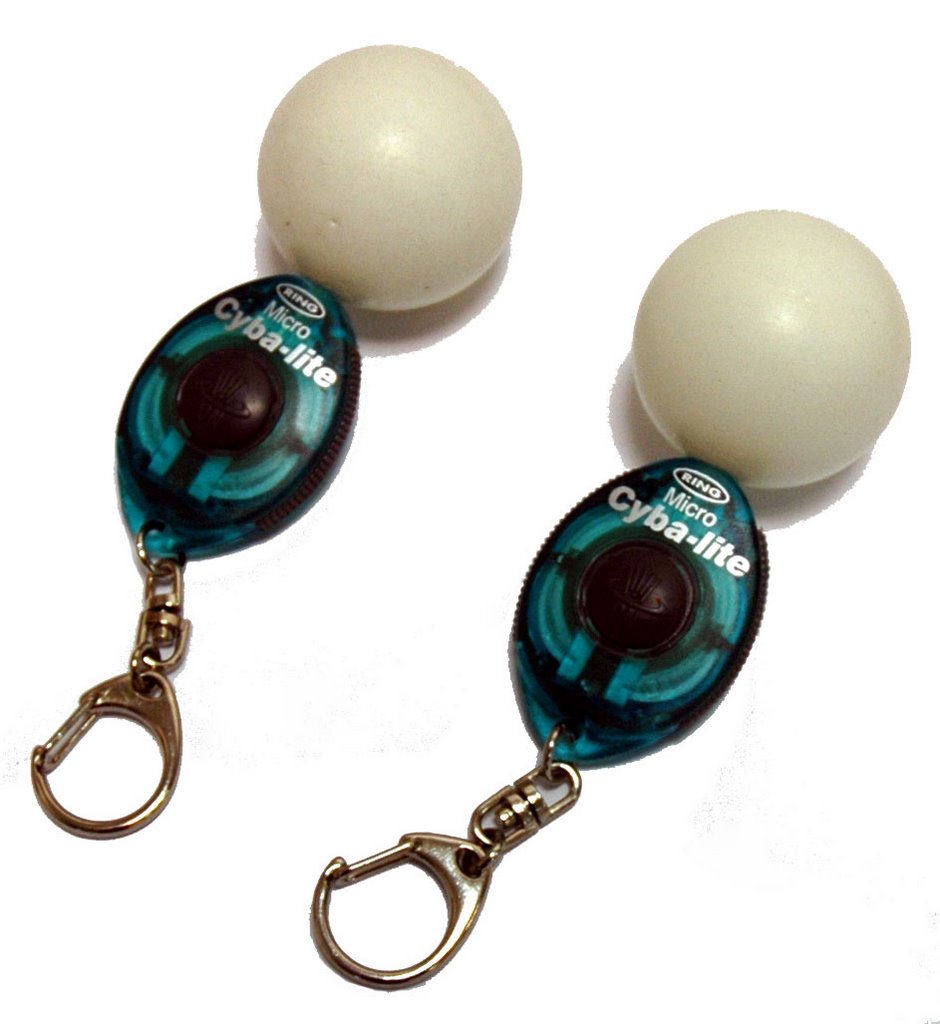
Using a pair of ping pong balls, that Joel our System Administrator found in a cupboard at home, a couple of led torches from down Tottenham Court Road and a touch of superglue we cobbled together our interpretation of the Atlas Glove controllers. (pictured right).

For our test we utilized a projector displaying Google Earth and the control software in a blacked out lecture theatre. This allowed a clear view of the lights which are turned on and off in combination with various hand gestures to remotely control Google Earth. The movie below demonstrates the trial, we were going to leave the movie audio free but couldn’t resist dubbing in the The Sorcerer’s Apprentice by Stokowski. The controller is Joel who quickly became a master of the technique.

Linking Google Earth to a remote vision based control interface is impressive and the fact it worked first time is testament to the teams clear instructions and software.

Of note to some users experiencing a ‘Grey Screen’ when loading the software, through trial and error we found that you also need to install WinVDIG version 1.1.1 (not the current 1.5 release). This enabled the control software to communicate with the webcam.

Microsoft Photosynth linked with Virtual Earth? – Automatic Generation of Digital Cities?

By Photosynth, Virtual Earth

Google Earth changed the way we see and distribute information, it made Geography important and for those working in the field of Geographical Analysis allowed them to quickly and easily share information. What it didn’t do was make the creation of content any easier, either in the second or thrid dimensions.

The third dimension is the tricky one, building Virtual Cities takes time and money, autogenerated 3D cities are some years away and if you combine this with the need for photorealism and the ability and zoom into minute details then you are talking a huge undertaking.

So what is needed is a new line of thought – A new process which takes normal everyday photographs which are cheap and easy to capture and mosaic them together into a 3D mesh so the camera is always looking directly from the angle the photograph was taken from. If you can pan between these angles and add as many photographs as you wish you can create a photographic mesh of a city. This is what Photosynth from Microsoft does and it has the sort of impact of when you first saw Google Earth – its a stand back moment and then you realise the implications.

The Photosynth Website features a video which talks you through the concept and shows some examples. Full details are sketchy at the moment but its looking like we could walk around a section of London taking images from as many angles as possible and then automatically create a virtual tour around it in 3D. Sure its not a full photogrammetric model but if it portrays a sense of location and space, linked to other media, then in some ways it is more valuable than a heavy polygon count model.

The final thought is linked to the fact that the demonstation video makes a passing mention of working with the team developing Virtual Earth. If this system is incorporated in Microsoft Virtual Earth then we have the possibility to link the ground photographs with oblique imagery via Microsoft Live and then create a full photorealistic 3D mesh from the view of Earth to the closest detail you can capture at macro level…..

Minority Report Interface to Google Earth

By Posts


Picked up via the ever impressive Oogle Earth Blog is the news that Atlas Gloves was Dan Phiffer and Mushon Zer-Aviv part of the ITP – NYU’s Interactive Telecommunication Program. have developed a pair of ‘Atlas Gloves’. The gloves are a DIY physical interface for controlling 3D mapping applications like Google Earth. The user interface is based around a pair of illuminating gloves that can be used to track intuitive hand gestures like grabbing, pulling, reaching and rotating. The Atlas Glove website has a video of the interface in action as well as details on how to build you own from a pair of ping pong balls, led lights and a webcam.

We are on the case and people are being dispatched to locate ping pong balls as we type. If we get it up and running we will put up a post as well as contacting the team to see if we can help out in any way with other applications such as ArcExplorer (?)….

****
As an update we have our ping pong balls (thanks Joel), super glue and a couple of cheap led torches. If we dont glue our fingers together we should be running a test this afternoon and updates will follow on our progress. (2nd August 2006).

****

Google Earth Canary Wharf

By Google Earth, Movies 10-20

Last Friday we posted a movie created of Canary Wharf from simply downloading the models at the Google 3D Warehouse. The models were created by
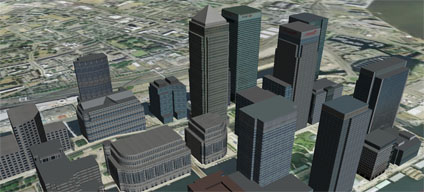
Olivier Salome (with the tag Jef at the 3D Warehouse) and we asked him to get in touch.. thankfully he did and he agreed to a short interview into how he built the model and his future plans. He also allowed us to post his latest Google Earth file of Canary Wharf which can be found at the end of the interview and is well worth a download. If you havent seen the movie already you can view it by clicking play below:

1) I notice you are based in Brussels, what got you interested in modelling London?

I am amazed to see the huge building effort London is taking to transform its skyline. In the City of London, 30St Mary Axe (Norman Foster, 180m) is one of the most ingenious and elegant new skyscraper built anywhere in the world. It will soon be joined by other stunning structures such as e.g. 122 Leadenhall Street (Richard Rogers, 224m) and the Shard London Bridge (Renzo Piano, 306m). In the Docklands, Canary Wharf has become one of the most vibrant and fast growing new business district in Europe and its tallest tower at One Canada Square (235m, Cesar Pelli) is also a remarkable piece of architecture. Then I came to know the excellent modelling work undertaken at CASA/UCL and in particular the 3D London models shared on the blog. I was so impressed at the results that I decided to try myself some simple modelling exercises.

2) Distance modeling is never easy, how to you get your data.. more especially the outlines of buildings, the heights and the textures?

Emporis is one of the world’s largest publicly available database on architectural and building data. Plans related to planning applications are published on the websites of the Corporation of London and Tower Hamlets. Architects, developers and letting agents also release some of the information I need to undertake 3D modelling. I would also like to mention the London forum thread on skyscrapercity where quality pictures are regularly posted as well as relevant architectural information and links.

3) Can you give us an idea of your work flow?

It takes time to collect all the information before I can actually start modelling with Google Sketchup. Buildings at Canary Wharf are not difficult to model – compared to e.g. 30St Mary Axe. However, it is difficult to ensure consistency in terms of colours, especially for those buildings in stainless steel and glass. Overall it took me about a month to make that model.

4) What buildings can we look forward to in the future?

Canary Wharf has started its new phase of mid-rise developments around Churchill Place on the eastern edge of the cluser. The two “Pan Peninsula” residential towers at the adjacent Millennium Quarter are also under construction. These will be added to the model. I have also started modelling New Providence Wharf opposite the Millennium Dome and Ontario Tower which is due for completion later this year. Meanwhile I am working on some buildings in the City of London.

In some ways it is amazing how quickly 3D modelling of cities has essentially become Open Source thanks to Google Earth and modellers like Jef. You can download his latest version of Canary Wharf from here (6Mb) and we thank Olivier for his time and look forward to some more more buildings in Olivier’s section of the Google 3D Warehouse.
Close Menu

About Salient

The Castle
Unit 345
2500 Castle Dr
Manhattan, NY

T: +216 (0)40 3629 4753
E: hello@themenectar.com

Archives