CASA Bike Route Map in Wired

By london cycle hire, wired

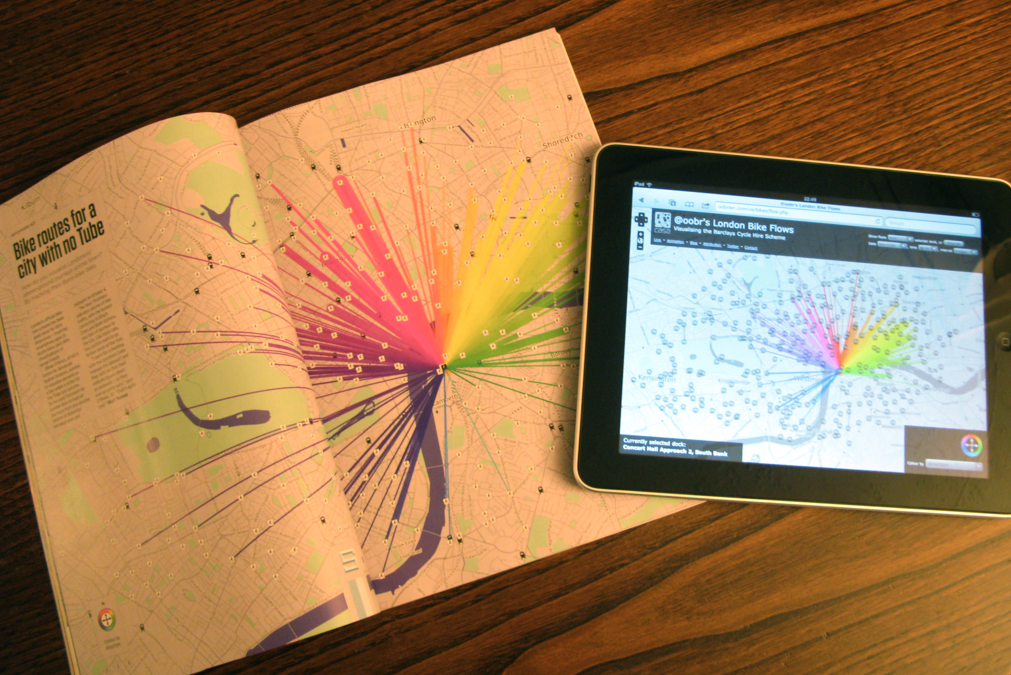
Ollie O’Brien’s work of the now widely featured Boris bikes visualisations gain a double page spread in this months Wired magazine.

Image courtesy of Adrian Short

Embedded below is a view of Ollie’s work as a timelapse to illustrate the distinctive weekday commuting patterns of the London cycle hire scheme:

You can run the animation direct via the Cycle Hire Dock Visualisation Map, and find out more about Ollie’s work at CASA and beyond via his Suprageography blog,

Twitter City Classification: The Mexican Bean Effect

By city twitter shapes, geo Twitter, twitter activity, urbantick

Over the past few years one of the PhD students I supervise here in CASA has been working on the way cities ‘tick’. Fabian Neuhaus is examining the temporal aspects of global cities and the results are interesting.

One recent piece of work that caught our eye was Fabians classification sample of nine cities ordered from evening to morning based on twitter activity. Some cities seem to be more active in the morning and other in the evening. Dubai and Istanbul for example are clearly more active in the late hours, where on the other end Cairo and Bogota are early birds and tweet a lot more in the morning. The US cities Boston and Atlanta have both a peak in the morning and in the evening.

We liked the way Mexico’s twitter activity is bean shaped:


Image by urbanTick for NCL / timeRose diagram of 24 hours – showing twitter activity in percentage of total tweets by hour of the day. Covers the cities Cairo, Bogota, Mexico City, Manila, Atlanta ,Boston Los Angeles, Istanbul, Dubai.

Similarly there are preferences regarding the weekdays, not all areas tweet the same day. The early week days, Monday and Tuesday are generally less active than the rest of the week. Manila clearly prefers the weekend, where Cairo, Istanbul and Mexico City prefer the end of the week, Thursday and Friday. Dubai and especially Bogota have the least differences between the weekdays with very similar numbers of tweets through out the week.

For more head over to http://www.urbantick.blogspot.com

Sneak Peak: QRCodes and iPads in The Grant Museum

By digital heritage, digital humanities, digital museums, ipads, QRator, tales of things, UCL
Here at University College London, the Grant Museum of Zoology, which contains some of the rarest extinct animal specimens in the world, is to re-open on 15 March, 2011 after an eight-month renovation and moving period. Over the past few months we have been working here in CASA with the nice people over at the Centre for Digital Humanities and UCL Museums to build interactive signage for the exhibits.
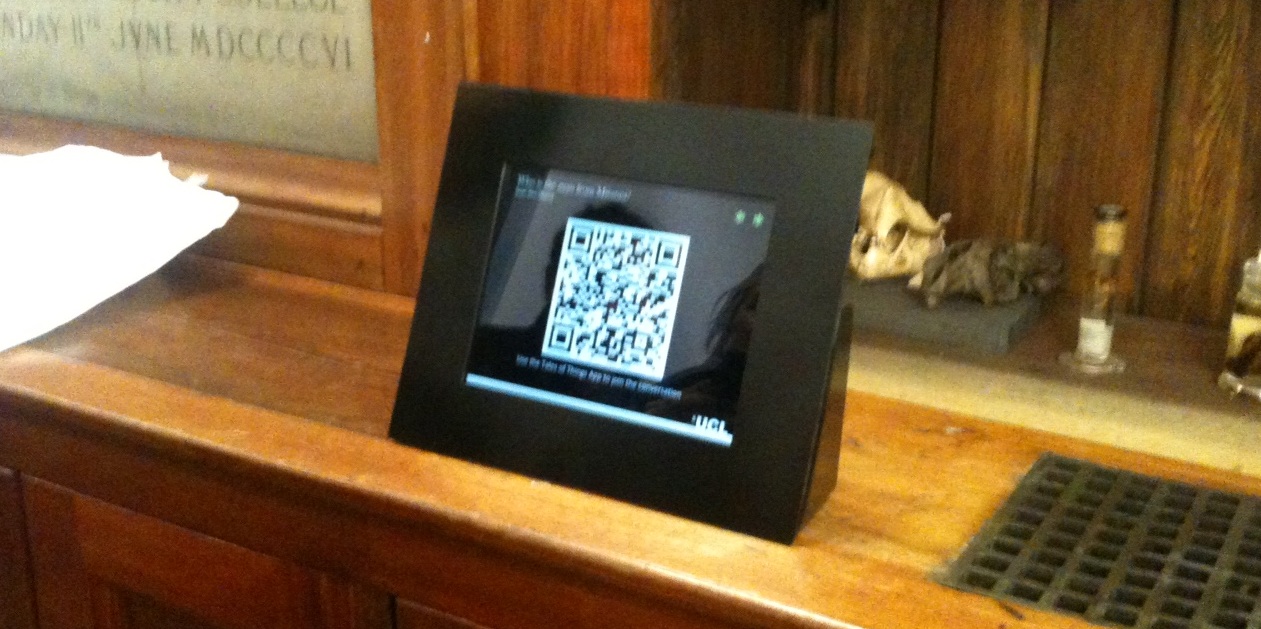
Based around the ‘Tales of Things‘ technology, each artefact has a QRCode and Twitter Hash Tag allowing digital conversations to be carried out both inside and outside of the museum space. In typical ‘sneak peak’ photo mode, below is a look at one of the iPad mounts:

We are not sure why all first look photos are blurred, but such is the case. The project, known as ‘QRator’ is placing 10 iPads around the museum to explore new models for public engagement and informal learning in museums using handheld mobile devices and new interactive digital labels. The aim is to enable the public to collaborate and discuss museum concepts and object interpretation with museum curators, and academic researchers.
Wired UK has a good article on the Museum with a mention of QRCodes, for a more in depth view of such matters head over to Digital Nerdosaurus.
We will have much more on QRator over coming weeks….

Introducing GEMMA: A Geospatial Engine for Mass Mapping Applications

By GEMMA, Geospatial Engine, inf11, JISC, jiscgeo, map mashups, mass mapping, Neogeography, Projects
GEMMA is the latest in a series of geospatial projects from the Centre for Advanced Spatial Analysis, here at University College London.
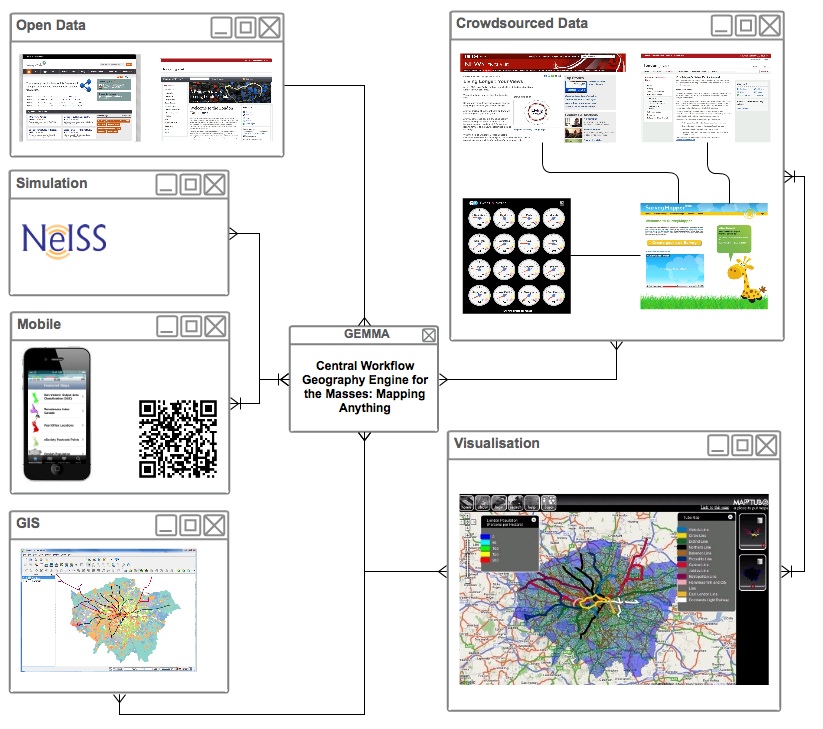
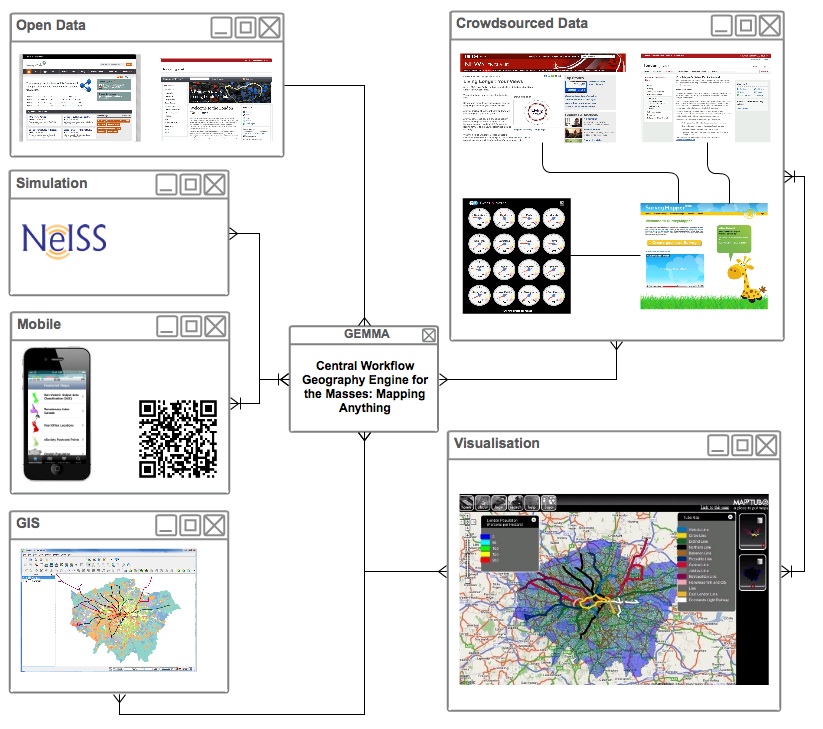
We are experiencing a massive explosion of online geospatial data from many new and unconventional sources from mobile devices to crowd-sourcing tools. Combined with newly released public sector information, we desperately need to integrate our tools for unlocking, exploiting, understanding and sharing these new data sets so that users can be provided with an accessible gateway to their display, mapping and spatial analysis.  Funded by JISC, GEMMA aims to produce a single workflow for the collection, mapping, preservation, sharing and visualisation of the geospatial datasets.
The Aim of GEMMA
What does that mean in short? The ability to create a map without knowing anything about mapping. Simple as, for too long creating a map has been too complicated, there is now a vast amount of geographically tagged information available online, yet to map it you still have to have a considerable amount of computer related knowledge. Not any more, and we are not talking standard pin type maps, we will enable complex spatial mapping to be carried out at the click of mouse and a point at a file.
 
This is what geospatial mapping should be, GEMMA aims to  bring ‘geo’ to the masses and not in a ‘neogeo’ type way, simply find some data, make, mix and display a map, that’s GEMMA in a nutshell.
 
 
With applications as wide ranging as community participation, social simulation, economic analysis, urban modelling and beyond, the collection, visualisation, analysis and ultimately understanding of these datasets requires new software organised around a new series of workflows which integrate an array of tools.
Over the next 8 months we aim to produce a one stop shop for any user who wishes to take public sector, crowd-sourced, mobile and related online data with geospatial reference which enables them to display and overlay this information in non-proprietary or freely available mapping services on the web such as Google Maps or Open Street Map, building on several tools that CASA has developed such as, MapTube and SurveyMapper.
What to Expect?
 
In typical CASA style, we will have frequent updates, beta releases and online apps. GEMMA will be integrated with various crowd sourced and open data sources complete with both iPhone and Android applications for viewing and collecting data in the field.
GEMMA kicks off March 1st, 2011, its time to make geo easy….
Close Menu

About Salient

The Castle
Unit 345
2500 Castle Dr
Manhattan, NY

T: +216 (0)40 3629 4753
E: hello@themenectar.com

Archives