
From Buildings to Cities: Techniques for the Multi-Scale Analysis of Urban Form and Function

By CASA, Cities, urban form, Working Papers
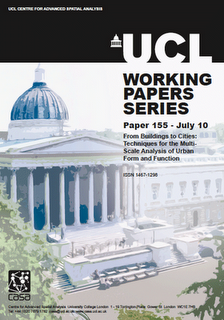
Duncan Smith here at CASA and Andrew Crooks, an assistant professor in the Department of Computational Social Science, at  George Mason University have just finished a new working paper entitled “From Buildings to Cities: Techniques for the Multi-Scale Analysis of Urban Form and Function.”

Below is the abstract :

The built environment is a significant factor in many urban processes, yet direct measures of built form are seldom used in geographical studies. Representation and analysis of urban form and function could provide new insights and improve the evidence base for research.
So far progress has been slow due to limited data availability, computational demands, and a lack of methods to integrate built environment data with aggregate geographical analysis. Spatial data and computational improvements are overcoming some of these problems, but there remains a need for techniques to process and aggregate urban form data. Here we develop a Built Environment Model of urban function and dwelling type classifications for Greater London, based on detailed topographic and address-based data (sourced from Ordnance Survey MasterMap).

The multi-scale approach allows the Built Environment Model to be viewed at fine-scales for local planning contexts, and at city-wide scales for aggregate geographical analysis, allowing an improved understanding of urban processes. This flexibility is illustrated in the two examples, that of urban function and residential type analysis, where both local-scale urban clustering and city-wide trends in density and agglomeration are shown. While we demonstrate the multi-scale Built Environment Model to be a viable approach, a number of accuracy issues are identified, including the limitations of 2D data, inaccuracies in commercial function data and problems with temporal attribution. These limitations currently restrict the more advanced applications of the Built Environment Model.

The full title of the paper and reference is:

Smith, D.A. and Crooks, A.T. (2010), From Buildings to Cities: Techniques for the Multi-Scale Analysis of Urban Form and Function, Centre for Advanced Spatial Analysis (University College London): Working Paper 155, London, UK.

You can download the paper direct (2.8Mb pdf) or view the complete 156 strong CASA Working Paper Series.

From Buildings to Cities: Techniques for the Multi-Scale Analysis of Urban Form and Function

By CASA, Cities, urban form, Working Papers
Duncan Smith here at CASA and Andrew Crooks, an assistant professor in the Department of Computational Social Science, at  George Mason University have just finished a new working paper entitled “From Buildings to Cities: Techniques for the Multi-Scale Analysis of Urban Form and Function.”

Below is the abstract :

The built environment is a significant factor in many urban processes, yet direct measures of built form are seldom used in geographical studies. Representation and analysis of urban form and function could provide new insights and improve the evidence base for research.

So far progress has been slow due to limited data availability, computational demands, and a lack of methods to integrate built environment data with aggregate geographical analysis. Spatial data and computational improvements are overcoming some of these problems, but there remains a need for techniques to process and aggregate urban form data. Here we develop a Built Environment Model of urban function and dwelling type classifications for Greater London, based on detailed topographic and address-based data (sourced from Ordnance Survey MasterMap).

The multi-scale approach allows the Built Environment Model to be viewed at fine-scales for local planning contexts, and at city-wide scales for aggregate geographical analysis, allowing an improved understanding of urban processes. This flexibility is illustrated in the two examples, that of urban function and residential type analysis, where both local-scale urban clustering and city-wide trends in density and agglomeration are shown. While we demonstrate the multi-scale Built Environment Model to be a viable approach, a number of accuracy issues are identified, including the limitations of 2D data, inaccuracies in commercial function data and problems with temporal attribution. These limitations currently restrict the more advanced applications of the Built Environment Model.

The full title of the paper and reference is:

Smith, D.A. and Crooks, A.T. (2010), From Buildings to Cities: Techniques for the Multi-Scale Analysis of Urban Form and Function, Centre for Advanced Spatial Analysis (University College London): Working Paper 155, London, UK.

You can download the paper direct (2.8Mb pdf) or view the complete 156 strong CASA Working Paper Series.

Second Life and Science Sim: Time to Head Back into Virtual Space(?)

By 3D Analyst, 3D GIS, arcGIS, opensim, sciencesim, Second Life

Back in the heady days of 2008 when Neogeography was the ‘in thing’ we looked into importing geographic, urban and climate information within Second Life. Progress was swift and we demonstrated how output from ArcGIS could be not only imported but also manipulated on the fly, along with step inside panoramas and live data feeds:

That was 2008, since then our land with NATURE in Second Life has sadly timed out and nowadays its hard to justify resources to rent virtual space. As such our thoughts are tuning to OpenSim, nothing new there of course but the clip below from Intel has got us thinking.

The movie demonstrates the progress in scaling the capabilities of the ScienceSim virtual world and features a collection of projects aimed at expanding the web to include interactive 3D applications.

ScienceSim is interesting and with the possibility of running several 1000 avatars on a server brings about interesting possibilities for virtual simulations.

For more information, see www.sciencesim.com

Second Life and Science Sim: Time to Head Back into Virtual Space(?)

By 3D Analyst, 3D GIS, arcGIS, opensim, sciencesim, Second Life

Back in the heady days of 2008 when Neogeography was the ‘in thing’ we looked into importing geographic, urban and climate information within Second Life. Progress was swift and we demonstrated how output from ArcGIS could be not only imported but also manipulated on the fly, along with step inside panoramas and live data feeds:

That was 2008, since then our land with NATURE in Second Life has sadly timed out and nowadays its hard to justify resources to rent virtual space. As such our thoughts are tuning to OpenSim, nothing new there of course but the clip below from Intel has got us thinking.

The movie demonstrates the progress in scaling the capabilities of the ScienceSim virtual world and features a collection of projects aimed at expanding the web to include interactive 3D applications.

ScienceSim is interesting and with the possibility of running several 1000 avatars on a server brings about interesting possibilities for virtual simulations.

For more information, see www.sciencesim.com

Close Menu

About Salient

The Castle
Unit 345
2500 Castle Dr
Manhattan, NY

T: +216 (0)40 3629 4753
E: hello@themenectar.com

Archives