AAG Conference, Boston

By aag, Conferences

We are heading off to the Association of American Geographers (AAG) Annual Conference in Boston on Wednesday. The AAG is always a good place to touch base with the latest research, we are presenting a paper on Saturday for those interested, the full details are below:

Abstract Title:
Web 2.0 and CyberInfrastructure: GeoVue Tools and Virtual Worlds for Geographic Visualisation

is part of the Paper Session:
Build it, Mapt it, Web it

scheduled on Saturday, 4/19/08 at 10:10 AM.

Author(s):
Andrew Hudson-Smith, Dr* – University College London

Abstract:

Web 2.0, specifically The Cloud, GeoWeb and Wikitecture are revolutionizing the way in which we present, share and analyze geographic data. In this paper we outline and provide working examples using our suite of tools which are detailed below, aimed at developing new applications of GIS and related technologies.

GeoVUE is one of seven nodes in the National Centre for e-Social Science whose mission it is to develop web-based technologies for the social and geographical sciences. The Node, based at the Centre for Advanced Spatial Analysis, University College London has developed a suite of free software allowing quick and easy visualization of geographic data in systems such as Google Maps, Google Earth and Second Life. These tools address two issues, firstly that spatial data is still inherently difficult to share and visualize for the non-GIS trained academic or professional and secondly that a geographic data social network has the potential to dramatically open up data sources for both the public and professional geographer.

With our applications of GMap Creator, Image Cutter, PhotoOverlay Creator, GEarth Creator and finally MapTube, we detail ways to intelligently visualize and share spatial data. This paper concludes with detailing usage and outreach as well as an insight into how such tools are already providing a significant impact to the outreach of geographic information.

Keywords:

google earth,web 2.0, second life, visualisation, google maps

Fingers crossed for good weather as we are packing our panorama kit, all being well our previously delayed (due to fog in Hong Kong) HDR tutorial should go online next week.

Agents in the City: Vision

By 3D Agents, 3D Modelling, Agent Based Modelling


Our last weeks series of posts on 3D Agent Based Models using 3D Max has been interesting (at least we have found it interesting). It is easy to set up any number of agents to swarm or wander within a set radius but adding behaviours beyond swarming is more difficult.

It seem to be down to ‘vision’ and how far the agents can ‘see’ ahead of them. In 3D Studio Max agents seem to only be capable of a complete 360×180 degree field of view or avoidance, this creates either large areas of exclusion or areas where agents fail to ‘see’ objects coming.

Our latest movie below illustrates this, the agents are now in our city model from the Greeble a City Tutorial:

At the moment the agents tend to get run over by the bus and roam inside the buildings, despite being set to avoid, still it is work in progress…

gisagents.blogspot.com have an interesting post on Pacman: is it an agent-based model? for those interested – a 3D Pacman would actually be quite easy as its a simple ‘Seek’ behaviour interlinked with paths.

Simulating Traffic in 3D Cities: Agents, Shockwaves and Grids

By 3D Agents, 3D Max, 3D Modelling, Agent Based Modelling


Simulating traffic is a science in itself with each car acting as an agent that is aware of its surroundings. It is notoriously difficult to create convincing traffic flow in 3D packages without input from specialist simulations and as such its a good challenge for our recent explorations of using agents in 3D Max to populate city models.

New Scientist highlighted the ‘Shockwave’ theory of traffic simulation this month with an article on how a team of Japanese researchers has recreated the phenomenon on a test-track for the first time.

The mathematical theory behind these so-called “shockwave” jams was developed more than 15 years ago using models that show jams appear from nowhere on roads carrying their maximum capacity of free-flowing traffic – typically triggered by a single driver slowing down.

With simple agents in 3D Max our first movie interestingly produces similar results:

If you then set up ‘three teams’ linked to a network with behaviour based on varying speed and avoidance calculations you can create a basic traffic flow simulation.

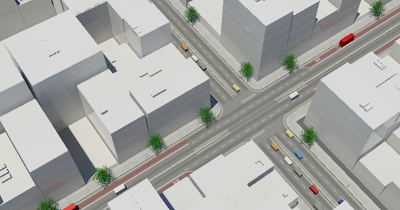
As we have said, these are first steps and there are some obvious issues to iron out with the aim to import the traffic flow into scenes such as our ‘Greeble City Tutorial‘ model illustrated below:

Interestingly the work going on just to our left using the Crysis game engine for traffic flow is proceeding at a notable rate, we should have a movie of this tomorrow…

Read more about the Shockwave Theory and NetLogo.

Towards Modelling Behaviour in 3D Cities: 3D Agents for Architecture

By 3D Agents, Agent Based Modelling, Crowd Simulation

The second in what is looking like a series of posts on 3D Agent Based Modelling in cities – in short on placing crowd, pedestrian and transport behavior into 3D models.

Yesterday’s post covered our first steps, developing ‘Ant Like’ behaviors on a surface, our next movie displays a degree of intelligence in our agents:

The agents are now aware of the environment around them and each other, as such they avoid collisions while wandering around the surface. As we mentioned this is ‘first step’ work and we are aware that there are advanced crowd simulations out there. We are taking a slightly different approach and as ever with the blog we will write a tutorial on the system soon as its more advanced.

It would be interesting to hear any thoughts on this line of posts and if you would like to know more about agents take a look at http://gisagents.blogspot.com/

Close Menu

About Salient

The Castle
Unit 345
2500 Castle Dr
Manhattan, NY

T: +216 (0)40 3629 4753
E: hello@themenectar.com

Archives