Is Google Maps GIS? Neogeography in The Cloud

By GIS, google maps, Neogeography

In the blogsphere (see High Earth Orbit and BlinkGeo) there is discussion going on about the role of Google Maps in GIS and indeed if Google Maps can be seen as GIS?

Google Maps (in our view) changed everything in the online geographic world. Where once data was restricted to slow and cumbersome servers from large GIS companies, Google came along and made it easy.

Google provided a base layer in essence on which to overlay information, a base layer that in the UK at least was hugely important due to the restrictive nature of copyright and use of maps online. In short Google has made mapping easy, opening up geographic information to the masses and leading the way to Neogeography, Crowd Sourcing Volunteered Geographic Information and Collective Intelligence.

In little under three years, mapping has become a central part of the Internet experience and indeed geography is important again. We are but at the beginning of what will be a revolution in social, visual and informational data plotted geographically by general users – Neogeographers. Mapping and visualisation is getting easier, we would argue that Google in three years has done more for the GIS industry than any of the big players in the last decade.


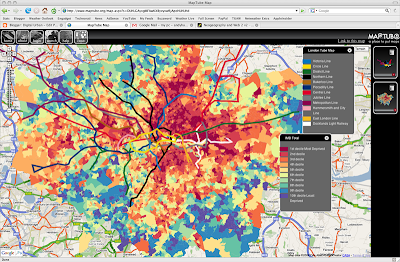
So is Google Maps GIS ? Not at the moment but then Google is not a GIS company. As third parties – such as our lab with MapTube and Google Map Creator – develop new toolsets the level of functionality will increase and with services increasingly existing on remote machines it looks like GIS is moving into The Cloud.

For more take a look at our working paper ‘Virtual Cities: Digital Mirrors into a Recursive World’. The paper comes explores visualisation in cities ranging from Twitter to Second Life and through to NeoGeography and The Paraverse.

Is Google Maps GIS? Neogeography in The Cloud

By GIS, google maps, Neogeography

In the blogsphere (see High Earth Orbit and BlinkGeo) there is discussion going on about the role of Google Maps in GIS and indeed if Google Maps can be seen as GIS?

Google Maps (in our view) changed everything in the online geographic world. Where once data was restricted to slow and cumbersome servers from large GIS companies, Google came along and made it easy.

Google provided a base layer in essence on which to overlay information, a base layer that in the UK at least was hugely important due to the restrictive nature of copyright and use of maps online. In short Google has made mapping easy, opening up geographic information to the masses and leading the way to Neogeography, Crowd Sourcing Volunteered Geographic Information and Collective Intelligence.

In little under three years, mapping has become a central part of the Internet experience and indeed geography is important again. We are but at the beginning of what will be a revolution in social, visual and informational data plotted geographically by general users – Neogeographers. Mapping and visualisation is getting easier, we would argue that Google in three years has done more for the GIS industry than any of the big players in the last decade.


So is Google Maps GIS ? Not at the moment but then Google is not a GIS company. As third parties – such as our lab with MapTube and Google Map Creator – develop new toolsets the level of functionality will increase and with services increasingly existing on remote machines it looks like GIS is moving into The Cloud.

For more take a look at our working paper ‘Virtual Cities: Digital Mirrors into a Recursive World’. The paper comes explores visualisation in cities ranging from Twitter to Second Life and through to NeoGeography and The Paraverse.

DU at the Science Museum

By Conferences

Slightly short notice on this one but we are at the Science Museum, London, tonight showing aspects of the Virtual London model and talking about its use in visualising local climate change.

Located at the ‘Dana’ Centre the full info for tonight is as follows:

Dramatic temperature changes, sudden rainfall and rapid changes in pollutant levels – our cities’ climates are becoming more and more difficult to predict. Architects and planners are faced with increasingly complex and uncertain information when shaping tomorrow’s cities. Does this mean there should be a radical rethink of how we develop urban space?

Join architect Nate Kolbe from the Superfusionlab practice as he shows off their ‘Snow City’ installation, a conceptual 3D model of London under deep snow. This extreme example serves as a starting point as we explore how climate catastrophes could affect cities, and what city builders and planners need to do to prepare.

Have your say with Geoff Darch as he talks about transport strategies to deal with flash floods or water shortages. And experts from the Centre for Advanced Spatial Analysis (thats us) will demonstrate computer models of London under water.

Come and give your opinion on what should be considered when designing the cities we live in…

This event is part of the London Festival of Architecture.

Event organised by:
The Science Museum

The event is free – Call 020 7942 4040 to book

Close Menu

About Salient

The Castle
Unit 345
2500 Castle Dr
Manhattan, NY

T: +216 (0)40 3629 4753
E: hello@themenectar.com

Archives